Key takeaways
- Building means running every layer yourself - licensing, custody, liquidity, compliance, and local banking in every market you serve
- Licensing sets the pace and the upfront cost - each market needs its own authorisation and minimum capital before the first payment
- Buying trades some control for speed - a provider brings these layers already in place, in return for ongoing fees
- The right choice depends on what you already run - existing licences and compliance reduce the build, but custody, liquidity, and local banking still need covering in every market
What stablecoin infrastructure includes
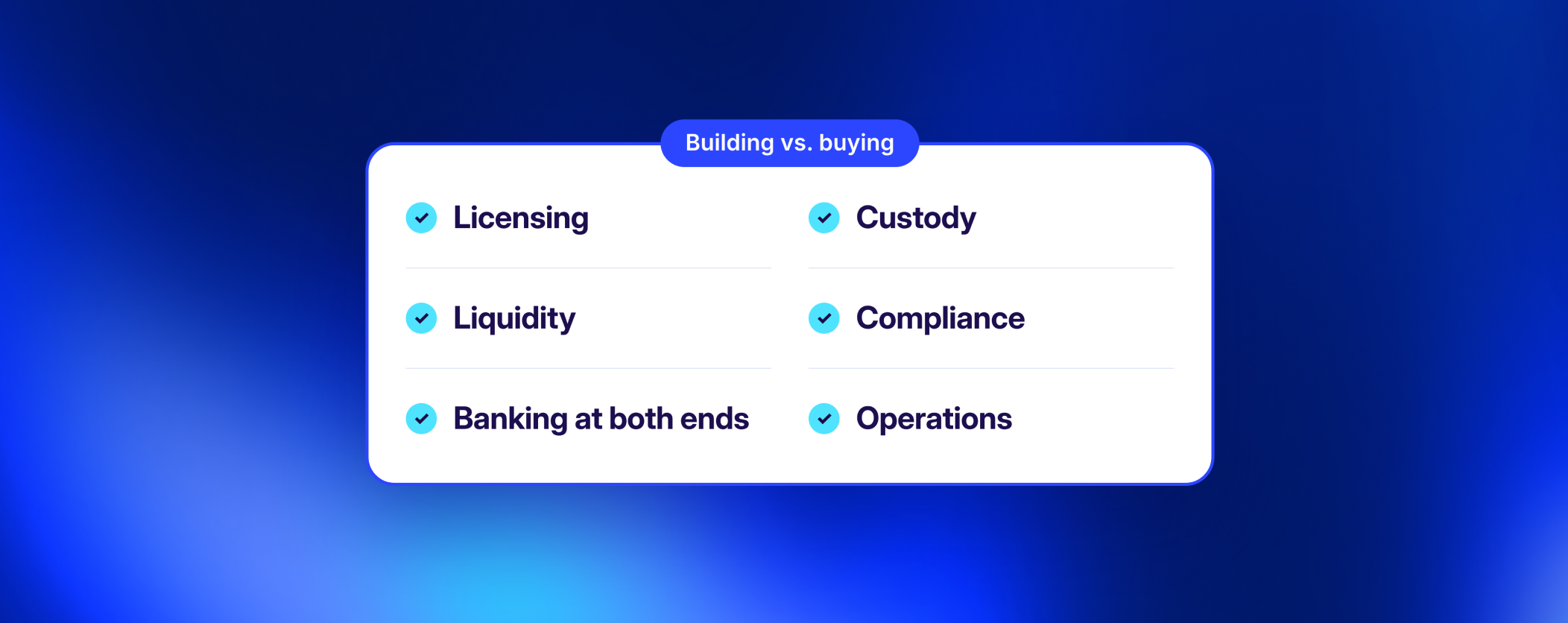
Running stablecoin payments takes more than access to a token. Each market needs a licence or a licensed partner, wallets need custody, someone has to convert between stablecoins and local currencies, every transfer needs compliance screening, and recipients need to be paid in local currency. Whichever route you take, each of these layers has to exist.
The case for building
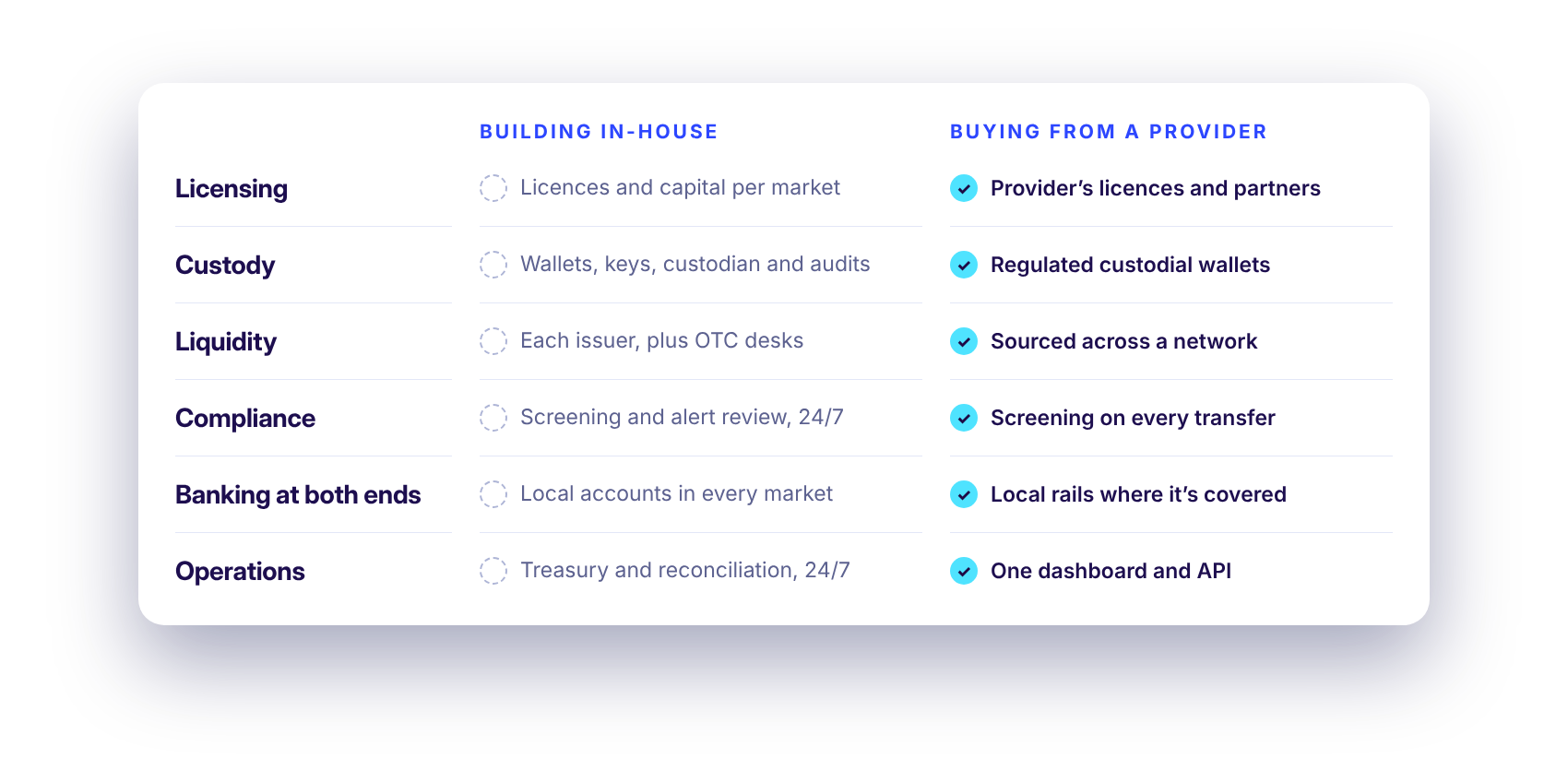
Building gives a company full control over its stack, its margins, and its roadmap, with fewer providers between it and its customers. It suits an institution that wants to run every layer itself and is ready to add custody, liquidity, and local banking in each market it serves, even where it already holds licences and a compliance function at home. On the issuance side, Société Générale went this way through SG-FORGE, its regulated subsidiary, which issues the bank's own euro and dollar stablecoins.
The cost is time and capital. Every layer has to be licensed, staffed, and running before the first customer payment, and the running costs continue every day after launch.
What it costs to build in-house
The first cost is licensing, and in the US moving stablecoins for customers is generally treated as money transmission, which means FinCEN registration and a licence in each state, each with its own net worth and bonding requirements. The EU requires MiCA authorisation as a crypto-asset service provider, with minimum capital of €50,000 to €150,000 depending on the services offered, and the UK will require FCA authorisation from October 2027, with minimum capital of £75,000 to £750,000. Each application also takes significant legal and compliance work, and the service can't launch until it's approved.
Running the stack then adds ongoing cost, since custody needs wallet and key management technology, a regulated custodian, insurance, and regular security audits. Liquidity depends on a separate account with each stablecoin issuer, plus exchanges or OTC desks for large conversions. Compliance work also grows with volume, as the Travel Rule applies to transfers of $3,000 or more in the US and to every crypto-asset transfer in the EU, and every screening alert needs someone to review it, including at weekends.
Why an issuer account isn't enough on its own
Many banks ask why they can't simply open an account with Circle or another issuer. They can, but the scope is narrow. An issuer account lets you mint and redeem that issuer's stablecoins against dollars or euros. Paying a beneficiary in local currency, screening your customers' transfers, adding stablecoins from other issuers, and banking in each market you pay into are still separate work.
Adding a wallet platform alongside an issuer account provides custody technology, but the licences, the compliance programme, and the local banking are still yours to build.
The case for buying
Buying puts those layers behind one integration. A provider brings custody, liquidity, compliance tooling, and banking in the markets it serves, so a company can add markets as its provider does. The trade-offs are ongoing fees, dependence on the provider's coverage and reliability, and less control over how each layer works.
If you buy, check whether the fiat on-ramps and off-ramps are regulated in the jurisdictions you operate in, who holds the keys and whether wallets are bankruptcy-remote and insured, which currencies and stablecoins are supported today, whether screening runs on every transfer before it executes, and how fees are structured.
Velocity provides these layers as a single platform for payments, settlement, treasury, and FX. It connects a global network of banks, custodians, and liquidity providers to support payments and settlement across 30+ fiat currencies and stablecoins, with balances held in regulated wallets that are bankruptcy-remote and insured. Card issuers on Thredd can connect through their existing Thredd integration and other businesses integrate with Velocity directly.
What to weigh before deciding
- How much of the stack you already run - existing licences, a compliance team, and banking relationships reduce what you’d have to build
- How much control you need - building puts every layer under your control, while buying hands custody, liquidity, and local banking to the provider
- Which markets you need - each new market means a licence, a local bank, and a payment-scheme connection if you build, and a coverage check if you buy
- How quickly you need to go live - licensing takes months in each market, while a provider lets you start with one high-friction flow on infrastructure that’s already running
- How costs compare at your volume - building is mostly fixed cost paid before launch, while buying is a platform fee plus fees that scale with volume
Frequently asked questions
1. Is it cheaper to build or buy stablecoin infrastructure?
It depends on your volume and how many markets you need. Building carries fixed costs before the first payment, from minimum capital in each market to custody, liquidity, compliance staff, and operations, while buying replaces most of that build with a platform fee and fees that scale with volume.
2. What should a bank or payment company look for in a stablecoin infrastructure provider?
Check that it operates under recognised payments or e-money frameworks, that its fiat on-ramps and off-ramps are regulated in the jurisdictions you operate in, and who holds customer funds and under what legal structure. It’s also worth confirming how it handles AML, sanctions screening, and transaction monitoring, and whether the setup can scale across regions without re-architecting compliance.
3. How long does it take a bank or payment company to go live with stablecoin settlement?
Building takes months, since every market needs its own licence, and under MiCA a regulator can take up to 25 working days to confirm an application is complete and 40 more to decide on it, before any pause for follow-up questions. Buying is quicker, because a pilot can run on the provider’s existing infrastructure without waiting for licences.
4. If you buy from a provider, who's responsible for compliance?
Both of you. The provider screens and monitors the transfers it runs, but your own AML, sanctions, and customer due diligence obligations stay with you. Regulators also expect banks and payment companies to oversee the providers they rely on, so plan for due diligence on the provider itself.
5.Do you need to hold stablecoins to use them for payments?
Not necessarily. Many providers let a payment start and end in local currency, with the stablecoin used to move value in between, so you can settle faster without holding stablecoins on your balance sheet.