
Much of the conversation around stablecoins has focused on payments.
That makes sense: Faster settlement is one of the most immediate and visible benefits of new financial infrastructure. For companies moving money across borders, the ability to settle faster can solve a real operational problem.
But for many finance leaders, payments are only the beginning.
As organizations begin exploring real-time settlement, a broader conversation starts to emerge around treasury, liquidity, and how capital moves through the business.
That is where Velocity sees a larger opportunity.
Every payment has a treasury consequence
Cash needs to be available when payments are made. Liquidity has to be positioned where the business needs it. Working capital decisions are often shaped by settlement timing, banking hours, and funding requirements.
For decades, treasury teams have built processes around those realities. They have learned to anticipate delays, prefund accounts, and manage liquidity across markets to make sure money is available when and where it is needed.
As settlement becomes faster and more flexible, those assumptions begin to change. The result is not just faster payments. It’s a different operating environment for managing capital.
Less idle capital, more flexibility
One of the largest costs in global treasury isn’t always obvious.
To manage uncertainty, finance teams often hold capital where it may be needed, even when that limits flexibility elsewhere in the business. Prefunded accounts and distributed liquidity can provide operational certainty, but they also create a tradeoff: more confidence that payments can be made, and less freedom to use capital efficiently.
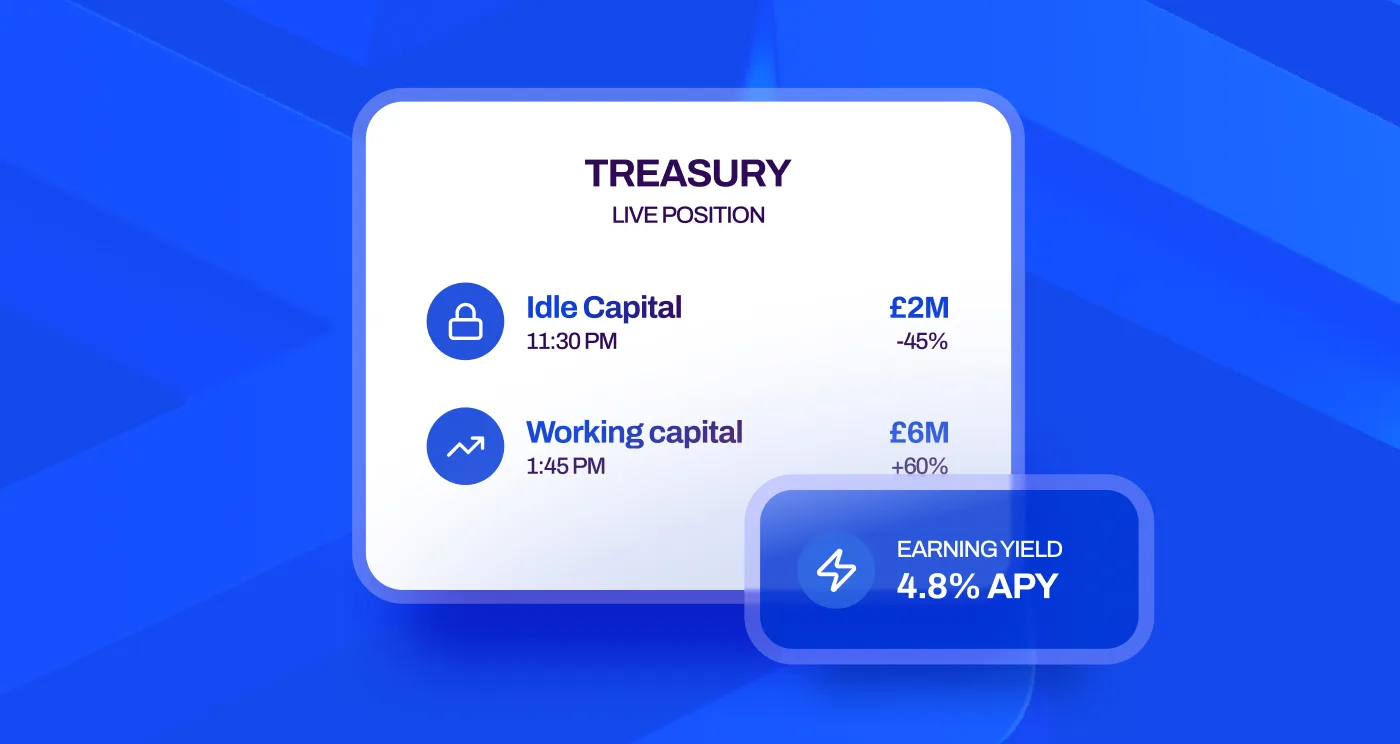
That tradeoff has long been part of doing business globally. But real-time settlement can begin to change the equation. When money moves faster, finance teams can operate with more flexibility. Cash can become available sooner, liquidity can be repositioned more dynamically, and capital that was once tied up supporting payment operations may be put to work elsewhere in the business.
For CFOs and treasurers, that can be more meaningful than speed alone.
Where yield fits in
Yield-bearing stablecoins have attracted significant attention, and for good reason.
But for most enterprise finance teams, yield is not the starting point. It is part of a broader treasury question: how can capital work harder while remaining available for operational needs?
The opportunity is not simply to chase yield. It is to build a treasury model where money can move more efficiently, remain more accessible, and potentially generate value when it is not actively being used for payments or settlement.
Viewed that way, yield-bearing assets become one part of a larger capital efficiency story.
They fit alongside real-time settlement, improved liquidity management, and reduced prefunding requirements as finance teams look for better ways to manage global cash.
Treasury is becoming more strategic
The role of treasury has expanded well beyond managing cash positions.
Today’s finance leaders are expected to support growth, improve resilience, optimize working capital, and help the business deploy capital more effectively. That requires more than visibility into where cash sits. It requires better infrastructure for moving and managing money.
As payments become faster and liquidity becomes more dynamic, treasury has an opportunity to shift from managing operational constraints to helping the business make better use of capital.
That is a different conversation than the industry was having only a few years ago.
It is also why Velocity has built treasury capabilities alongside payments. Modern money movement and modern treasury are increasingly part of the same operating model.
From moving money to managing capital
For finance teams, faster settlement is only part of the story. The larger opportunity is managing capital with greater flexibility and efficiency.
Faster settlement can solve immediate pain points, but the broader value comes from how it changes the way treasury operates.
Faster payments may be the first benefit companies see.
More effective capital management may prove to be even more impactful.
.png)