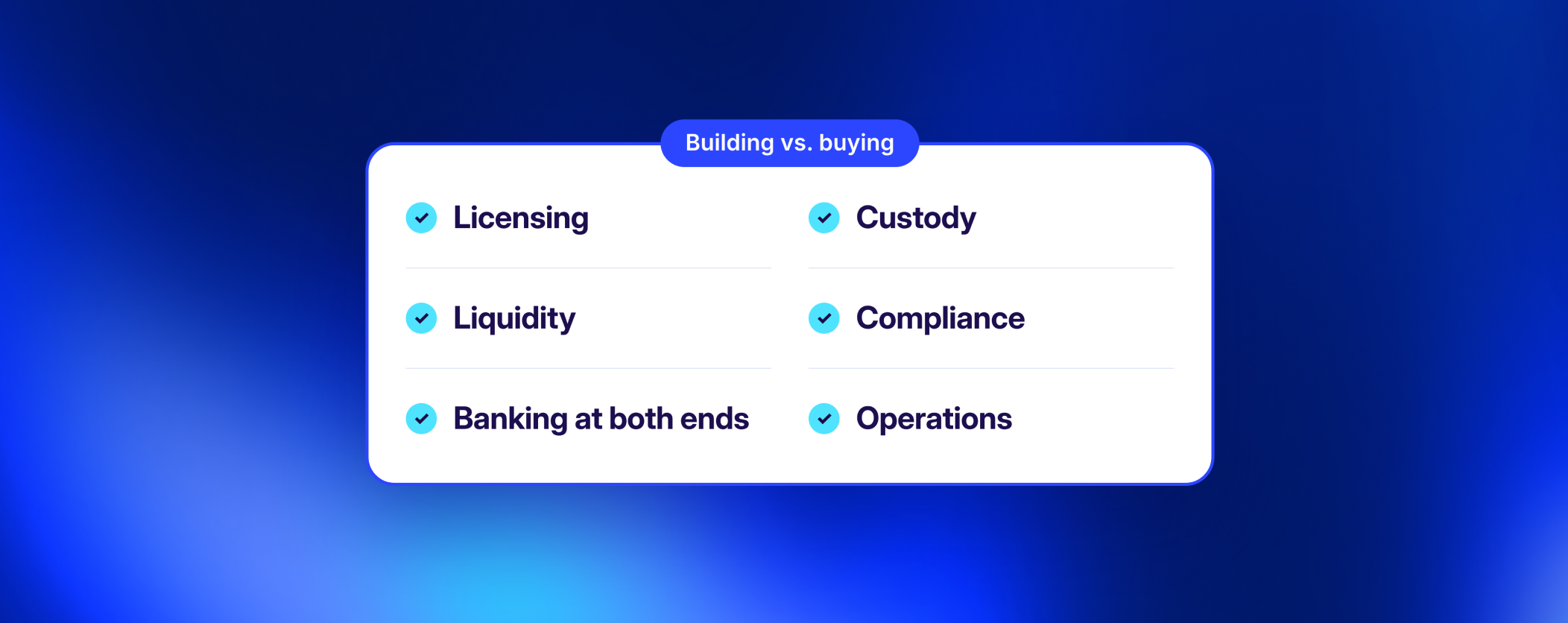

Key takeaways
- The largest cost never appears on an invoice - the capital tied up in each buffer usually far outweighs transfer and account fees, and the bank's FX spread adds more on every top-up
- Treasury teams size each buffer for the worst case - several days of payout volume in every market, with extra on top for late transfers, weekends, and busy periods
- Basis points make every corridor comparable - expressing the annual cost in basis points gives you a benchmark to compare alternative options
- Faster funding shrinks the buffer - when money moves in minutes, 24/7/365, a business can fund payouts right away instead of holding days of volume in every market
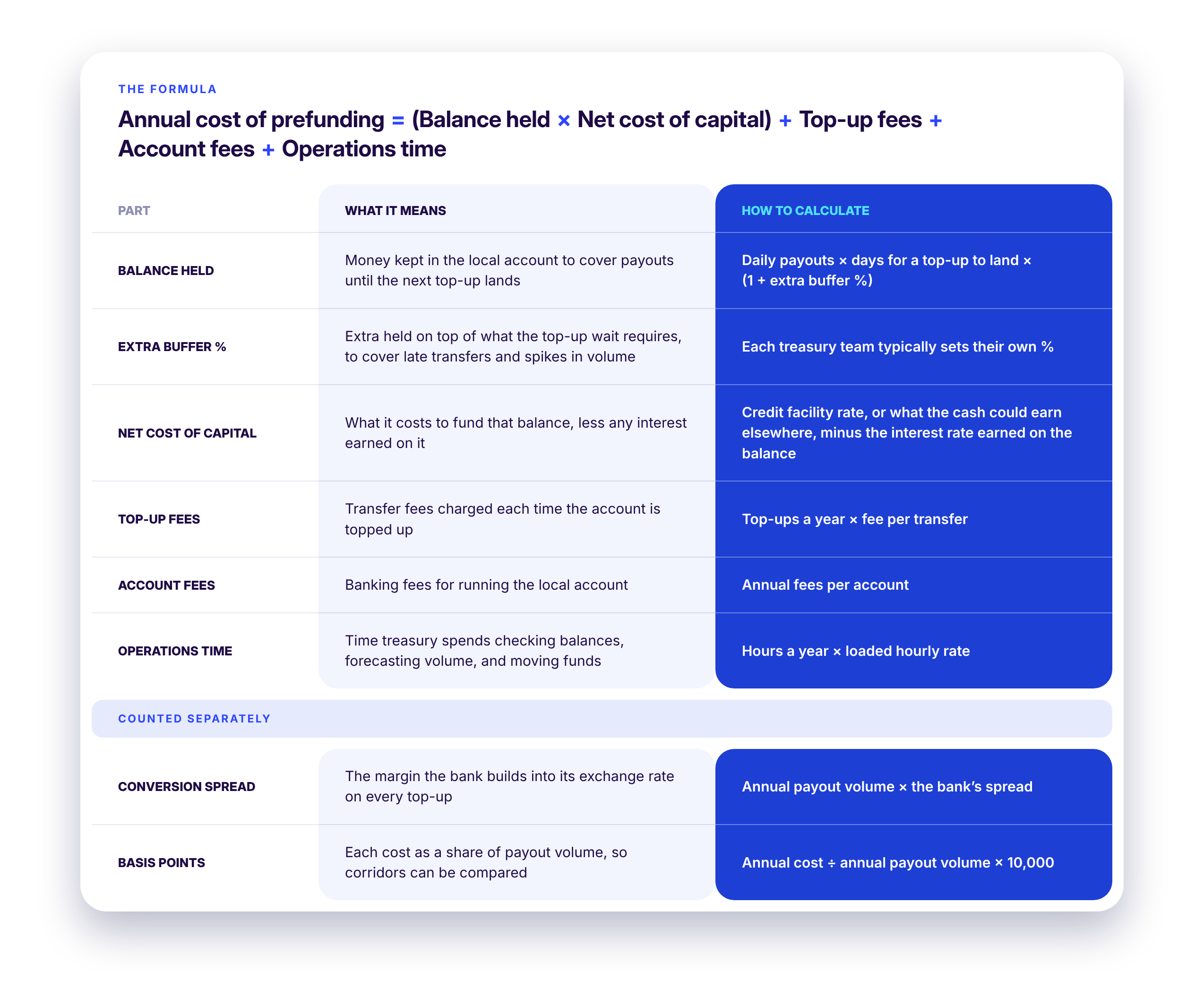
The formula for calculating annual costs of prefunding
Where the cost of prefunding sits
A payout business needs money in each market before it can pay out, so treasury typically keeps a balance in every local account, enough to cover payouts until the next top-up arrives (plus a bit extra in case a transfer runs late or volume jumps). That balance rarely shows up as a cost. It's spread across treasury, finance, and operations, and nobody receives an invoice for it.
The biggest cost is the capital itself. Money sitting in a local account can't be used anywhere else, and that's before transfer fees, account fees, and the hours spent managing balances. The bank's FX spread on each top-up is a cost too, but it belongs on its own line, because any way of funding payouts across borders involves converting currency. Working out what each corridor actually costs gives treasury a real number to compare against alternative methods of funding payouts, using the calculation below.
How much capital is sitting idle in each market
Most treasury teams size each buffer around how long it takes a top-up to reach the local account, which in practice means holding several days of payout volume in every market, with extra on top for late transfers and busy periods. Top-ups through correspondent banks take two business days on average and don't move at weekends or on bank holidays, so funds sent on a Friday afternoon may not arrive until Tuesday, and the buffer has to cover that gap.
Then there's what that capital costs. If the buffer is funded from a credit facility, it's the interest rate on the facility. If it comes from the business's own cash, it's what that cash could have earned elsewhere, and short-term government bill rates are a fair minimum to use.
The business rarely earns much of this back in interest, because the bank or partner holding the balance typically keeps the interest income on that capital. Unless it has negotiated a share, it receives little or none of it, and whatever it does receive comes off its cost of capital.
What you pay every time you top up
Every time treasury tops up a local account, the bank converts the funds at its own exchange rate with a spread built in. The spread covers every payout in the corridor, so on a busy corridor it's usually the largest single cost, and treasury teams rarely see it because it's built into the rate. Any other way of funding payouts still involves a conversion, so this cost is compared against the alternative's spread rather than removed.
Alongside the spread, each top-up carries a transfer fee, each local account has its own banking fees, and someone in treasury spends hours every week checking balances, forecasting volume, and moving funds. Treasury teams should price that time at a loaded hourly rate and add it to the total.
What prefunding costs on one corridor
To see how these costs add up, take a payout provider sending £1.5 million a day to recipients abroad, every day of the year. It funds its buffer at a 6% cost of capital, earns no interest on it, and pays a 0.25% spread each time its bank converts a top-up. The figures are illustrative.
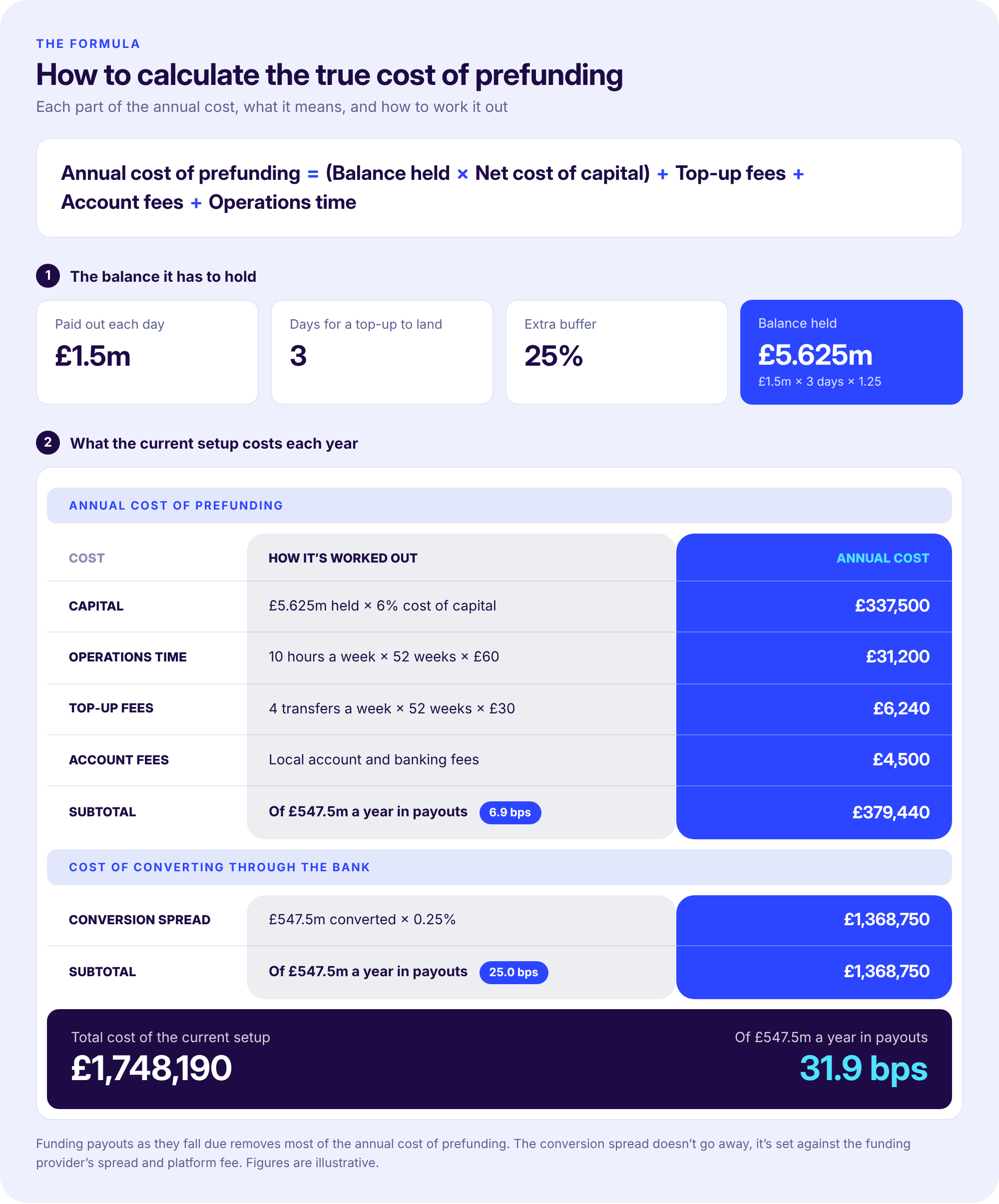
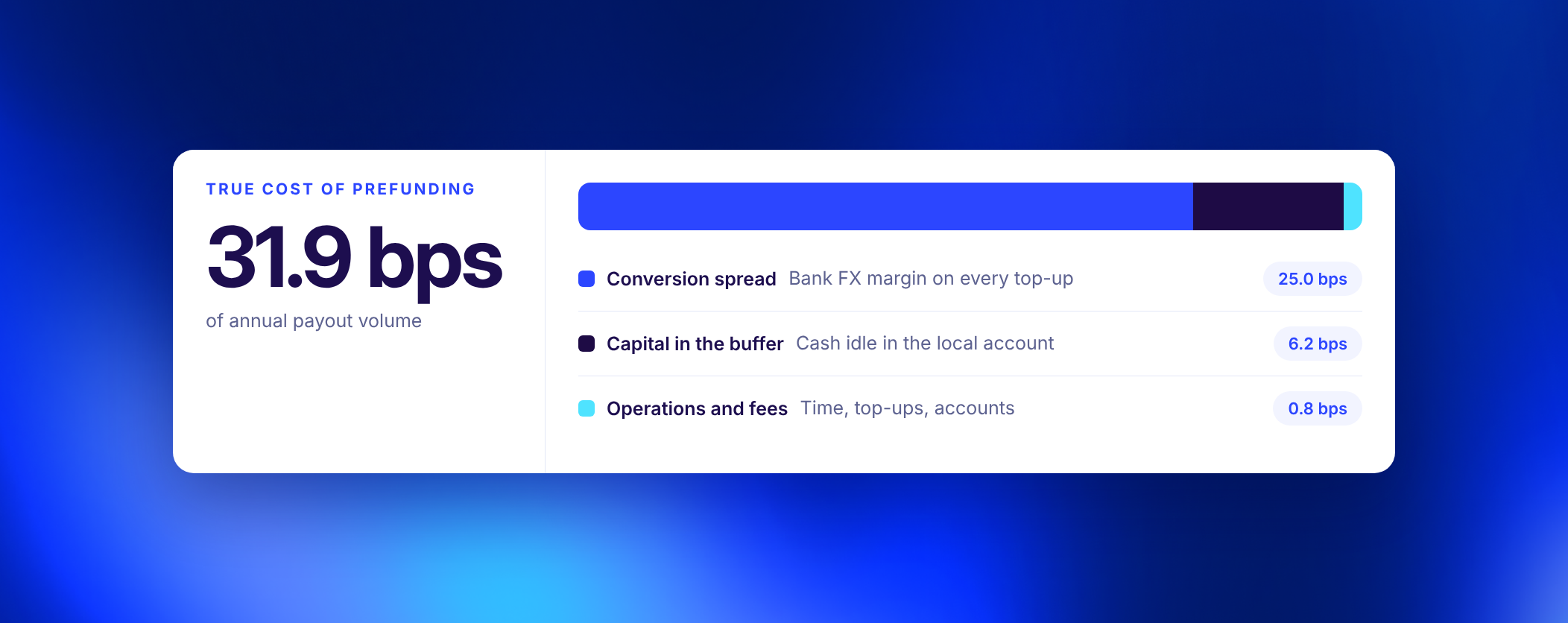
The annual cost of prefunding this corridor is £379,440, or 6.9 basis points of payout volume, and almost 90% of that is the capital tied up in the buffer. The transfer and account fees on the bank's invoices come to about £11,000. The bank's conversion spread adds another 25 basis points, bringing the cost of the current setup to 31.9 basis points. When treasury teams work out the same figures for every corridor, they can see where prefunding costs them most and have a clear benchmark for any alternative.
How to bring the cost down
Businesses prefund because banking rails can't get funds to the destination in time for each payout. Stablecoins move in minutes, 24/7/365, including weekends and bank holidays, so a payout business can fund each payout as it's due instead of keeping a buffer in every market. Visa introduced stablecoin prefunding pilots for Visa Direct in 2025 and moved them into commercial deployment in October 2026. We cover how the model works in Rethinking Prefunding for Payouts with Stablecoins.
In the example above, a provider funding payouts this way would no longer carry the £337,500 capital charge or most of the top-up fees, so most of the 6.9 basis points it spends on holding a buffer goes away. It would still pay some account fees and spend some time on operations. Its choice on conversion then comes down to the bank's 25 basis point spread against the funding provider's spread and platform fee, plus the small cost of funds in transit.
For corridors that still run on banking rails, treasury teams can lower the cost in two ways in the meantime. They can hold one central balance and deploy it where it's needed, which covers several markets with less capital than a separate buffer in each, and they can negotiate a share of the interest the partner earns, which brings down their net cost of capital.
Frequently asked questions
1. What is prefunding?
Prefunding is money a business sends to its accounts in other markets ahead of time, so it can pay recipients locally without waiting for a cross-border transfer to arrive. The balance has to cover every payout until the next top-up lands, which ties up capital in each market it serves.
2. How do you calculate the true cost of prefunding?
Start with the balance held in each market and multiply it by the net cost of capital. Add top-up fees, account fees, and the time treasury spends managing balances, then divide the total by annual payout volume and multiply by 10,000 to express it in basis points. Work out the bank's conversion spread the same way but keep it separate, since any way of funding payouts carries a conversion cost.
3. How do weekends and bank holidays affect prefunding?
Correspondent banking transfers don't move at weekends or on bank holidays, so a buffer has to cover every day a top-up can't arrive. Funds sent on a Friday afternoon may not land until Tuesday, which is why buffers are sized for the longest gap rather than an average day.
4. Is it cheaper to prefund or to fund payouts as they fall due?
It depends on the corridor, so compare the two in basis points of volume. A business that prefunds pays for the capital tied up in its buffer and the bank's conversion spread, and a business that funds payouts as they fall due pays the provider's spread and platform fee. The longer a top-up takes to land, the more capital the business frees up by switching.
5. Can stablecoins reduce prefunding?
Yes. On stablecoin rails a payout business can fund each payout just in time, so it no longer has to hold a buffer in every market days in advance.