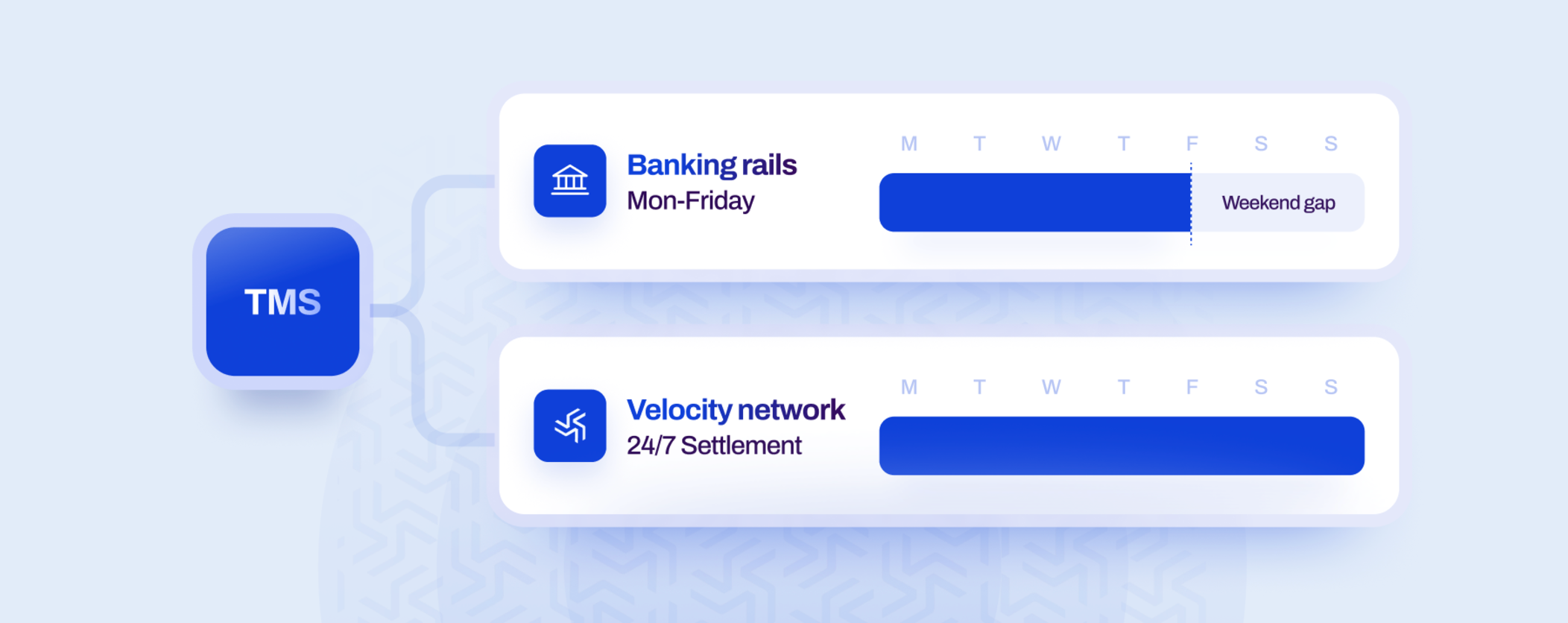

One of the first principles we set when engineering the automation suite within the Velocity platform was that any capability had to sit alongside whatever a customer already uses to run treasury, not try to replace it.
Some of our customers run treasury through a treasury management system. Others have built their own in-house solutions, often over years, and have no intention of ripping them out for us. Either way, the principle is the same: customers should not have to change how they make decisions, who approves what, or where their ledger and system of record live in order to take advantage of stablecoins and 24/7 settlement.
What we are building has to sit underneath whatever is already there and extend it into the onchain world.
That distinction matters because a treasury management system and an execution layer solve different problems. The TMS remains the place where a treasury team defines policy, controls permissions, manages approvals and maintains its view of the balance sheet. Velocity extends what that system can actually do once money needs to move across stablecoins, blockchains and domestic banking rails, particularly outside the constraints of the traditional banking day.
There are two treasury use cases that come up in customer conversations time and time again, and that we think are particularly well suited to this model.
The first is just-in-time funding.
Today, a lot of cross-border payment infrastructure still depends on money being pre-positioned in-market so that it is available for drawdown through domestic rails when a payment needs to be made. That works, but it ties up capital and forces treasury teams to forecast liquidity around the operating hours and settlement characteristics of local banking systems.
With Velocity's network, money can instead move when it is actually needed. Our automation tooling allows funding and execution to be triggered when a defined threshold is reached, 24/7, rather than requiring balances to sit idle in advance.
The second is asset repositioning out of hours.
Banking cut-offs create long periods where capital can become effectively static, even though the economic requirement to manage that capital has not changed. Through Velocity's stablecoin and domestic banking network, balances can be shifted automatically into a different asset once banking cut-offs pass, and shifted back when banks reopen.
The point is not simply that stablecoins move 24/7. It is that treasury teams can use that continuous settlement layer without themselves having to become a 24/7 operation. Capital does not need to sit idle, or worse, leave a business short over an entire weekend simply because the banking system has stopped moving.
To deliver these use cases in a way that is usable for treasury teams, we have zeroed in on two specific gaps that neither a treasury management platform nor an in-house stack will typically close on its own.
1. The Visibility Gap
Anything that requires visibility into a multi-blockchain stablecoin execution layer generally sits outside what a traditional TMS was built to monitor.
A deposit clearing outside the banking day, an automated conversion taking place overnight, or a sweep running through an entire weekend still needs to be visible and controllable. If something goes wrong, the right people need to know about it, even if the treasury or operations team is running with skeleton coverage.
That visibility necessarily originates on our side, because that is where the movements actually take place.
We have therefore built real-time reporting and alerting around every automated action within Velocity. Customers can consume that information in-platform, through email and other alerts or, where supported, directly within the TMS or systems they already use.
The objective is not to create another dashboard that treasury teams need to live in. It is to make activity taking place in the execution layer observable within the customer's existing operating and control framework.
2. The Infrastructure Gap
The banking rails that sit underneath global payments are still largely built around the concept of a business day.
There are batch windows, overnight cycles, cut-off times, closed weekends and public holidays. Treasury management systems have evolved around that reality because, historically, there has been little value in designing workflows for periods when the underlying financial infrastructure itself cannot move money.
Stablecoin infrastructure changes that constraint.
Continuous operation exists on our side through Velocity's network, but that does not mean the customer's treasury system needs to become a 24/7 execution engine as well. Instead, a treasury team can define the policy and conditions under which an action should happen, while Velocity handles the actual out-of-hours execution.
A transaction can, for example, be instructed through the customer's normal process during the banking day, with the actual sweep left to Velocity once banking hours end. Reporting remains available throughout, while the actions themselves can be tracked and reconciled back into the customer's system of record.
In that sense, the rules engine is not replacing the TMS. It is giving the TMS reach into infrastructure it was never designed to operate across directly.
The system of record stays the system of record
None of this asks a treasury team to fundamentally change how it operates.
The decisions can stay where they are made today. The approvals can stay with the same people. The ledger and system of record can stay exactly where they are.
Velocity sits underneath that existing architecture and handles the part that traditional treasury infrastructure cannot easily handle on its own: continuous execution across stablecoins, blockchains and banking rails, with the visibility and controls required to make that execution operationally usable.
That is what we mean when we say the rules engine enhances rather than replaces a treasury management system.
The opportunity is not to rebuild treasury around stablecoins. It is to use stablecoins to remove some of the constraints treasury teams have historically had to design around, whether that is pre-funding, trapped capital or the simple fact that money stops moving when the banking day ends.
With Velocity and our automation suite, customers can fundamentally change how efficiently their money moves without having to fundamentally change how their treasury function is run.