A new rail, wired through the stack you run
Done right, a stablecoin balance sits alongside fiat balances, card authorisation, network settlement and payouts under the controls the programme already has, and the issuer has nothing new to operate.
In September 2026, Visa reported that stablecoin settlement on its network had passed a $20 billion annualised run rate, up more than fifteen-fold year on year, with more than 160 stablecoin-linked card programmes live and payment volume on them growing nearly 200% (Visa, 8 Sep 2026). In June 2026 Mastercard opened its global network to settlement in six regulated stablecoins across eight blockchains, with intraday, weekend and holiday settlement for issuers and acquirers (Ledger Insights). The direction is clear: stablecoins are increasingly being incorporated alongside established payment rails rather than simply replacing them.
Now that the networks have made their move, the question for an issuer is no longer whether stablecoins will touch the programme, but how the stack underneath it will handle them.
Making stablecoin useful in an existing issuing environment requires specialist money movement capabilities and the processing infrastructure around them. Thredd and Velocity bring complementary strengths:
Issuer processing
Card transaction processing, authorisation, scheme connectivity, controls, APIs, and ledger and reconciliation services. These are the capabilities that help clients operate and manage card programmes across markets.
Stablecoin infrastructure
Programmable wallets, conversion between fiat and stablecoins, movement of funds on-chain, liquidity and compliance screening. The layer that lets an issuer hold money in the most useful operational currency for longer and release the capital currently trapped in prefunding.
In September 2026 the two companies announced a partnership that connects these layers through the Thredd integration issuers already have.
This is part of a wider change in payments: wallets, programme accounts and payment platforms are becoming less dependent on a single funding source or a single rail. Cards will continue to matter, as will banking payments. Stablecoins add another option where the operating conditions justify it. The useful question is therefore not whether one rail will win, but which flows could work better when issuers have more than one option.
How to read this report
Every chapter comes back to the same three questions, because they are the ones an issuer's board will ask:
Use case
What existing payment problem is being solved?
Efficiency
What improves in time, liquidity or complexity?
Implementation
How can a business adopt this without becoming crypto-native?
“The real opportunity with stablecoins isn't a new asset, it's a more programmable way for businesses to move and manage money globally.”
“Clients should not have to rebuild their payments stack to take advantage of them.”
Stablecoins, explained
A stablecoin is a digital token issued on a blockchain that is designed to hold a fixed value against a fiat currency, most often one US dollar.
Each token is backed one-for-one by reserves (cash and short-dated government debt) held by the stablecoin issuer, and can be redeemed for the underlying currency. The stablecoin an issuer is most likely to encounter is USDC (issued by Circle), and, for euro flows, EURC.
The important point for a card issuer is what a stablecoin is not. It is not a speculative currency. Its value does not move. It carries none of the volatility that made earlier digital assets unsuitable for settlement.
What it does carry is the infrastructure underneath: a shared ledger that is open 24 hours a day, 365 days a year, where a transfer is final in seconds and visible to both parties in real time.
Why that matters to issuers specifically
An issuer's business is built on timing. You authorise a cardholder's spend now, settle with the network later, and bridge the gap with capital you have put up in advance. Every one of those steps today depends on bank rails that observe weekends, holidays and currency-specific cut-off times. A stablecoin is simply money that does not observe them.
| Fiat on bank rails | Stablecoin on-chain | |
|---|---|---|
| Hours of operation | Business days, local cut-offs | 24/7/365 |
| Settlement finality | T+1 to T+4, longer cross-border | Seconds to minutes |
| Cross-border path | Correspondent bank chain, each adding FX and fees | Same asset, usable in any market |
| Visibility | Statements and reconciliation files | Every transfer traceable on a shared ledger in real time |
| Volatility | None | None (pegged, reserve-backed) |
| Programmability | Logic built externally | Native support for automated, conditional payments |
Who issues them and who backs them?
Reputable stablecoins are issued by regulated firms under e-money, trust or banking licences, with reserves attested or audited and published. Regulation now defines what counts as a compliant stablecoin in the EU, the UK and the US. The stablecoins used on Visa's and Mastercard's settlement rails are all from this regulated tier.
Three terms worth knowing
On-ramp / off-ramp
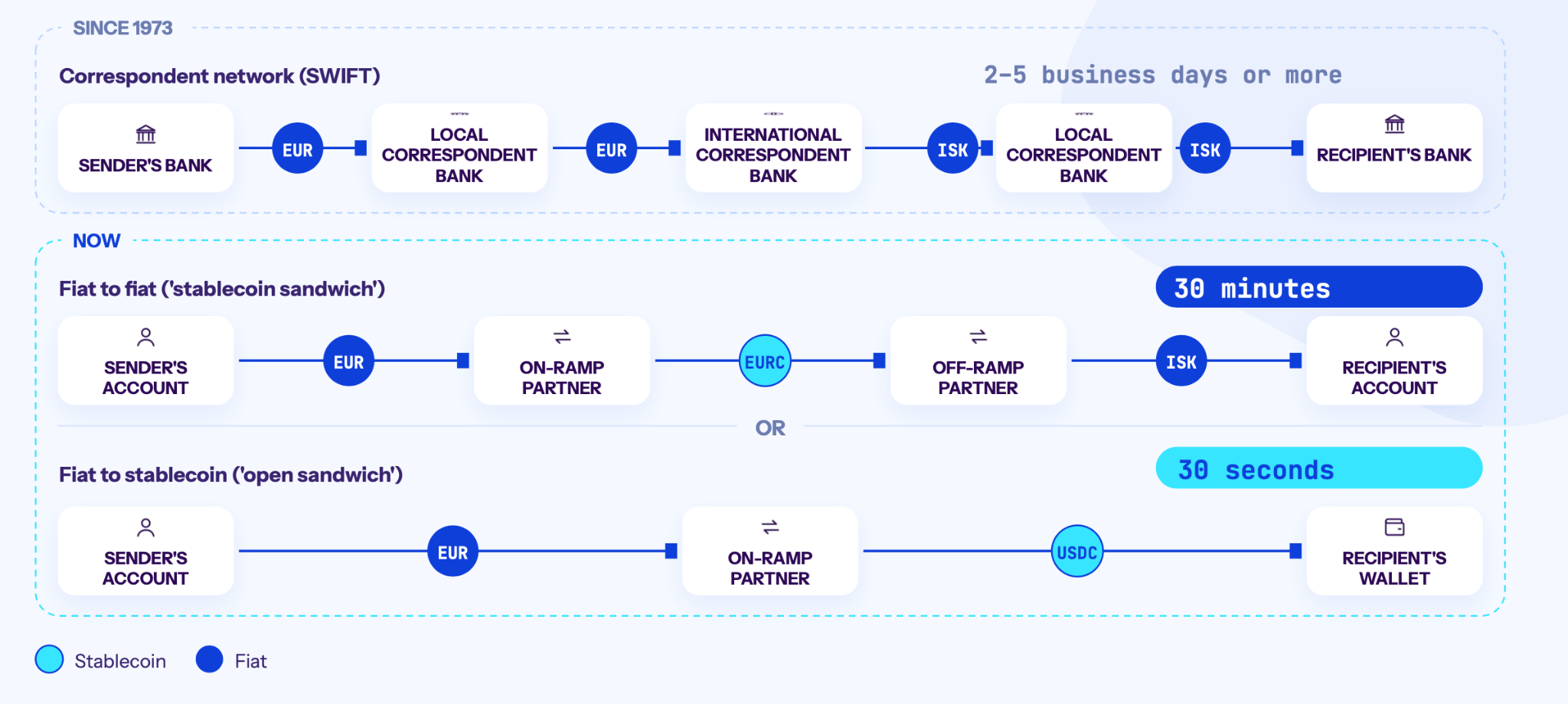
Converting fiat into stablecoins, and back. A regulated conversion partner does this at a quoted rate, in real time.
Wallet
The account that holds a stablecoin balance on-chain. For an institution this sits with a regulated custodian, with controls, approvals and audit trails equivalent to a bank account.
The stablecoin sandwich
A payment that starts and ends in fiat but travels as a stablecoin in the middle. The sender pays in euros, the value moves on-chain in seconds, and the recipient receives their local currency. Neither party has to hold a stablecoin, which is why this pattern has become the entry point for most institutions.
The scale of what is already moving
Payments are now the fastest-growing use of stablecoins, and the institutions building on them are the ones that run card settlement.
in stablecoin payments (not trading) in the first eight months of 2026, up 42–63% YoY. B2B is the largest lane at an estimated $137–153 billion, and 43% of B2B stablecoin volume crosses a border.
Allium, State of Stablecoins and Payments, Sep 2026, as cited in Visa's 1 Oct 2026 releaseannualised stablecoin settlement run rate on Visa's network as of September 2026, up more than 15x year on year.
Visa, 8 Sep 2026; Visa, 1 Oct 2026stablecoin-linked card programmes are live, with payment volume up nearly 200%.
Visa, 8 Sep 2026; Visa, 1 Oct 2026in stablecoins in circulation at the May 2026 peak.
DefiLlama-based trackersWhen always-on programmes rely on less flexible funding
The strongest stablecoin use cases improve something a business already does. They do not require it to rebuild itself around a blockchain.
So the right place to begin is not the technology but the friction: where, in the flows an issuer already operates, do timing, cost and complexity bite today?
Card programmes can authorise purchases around the clock, while some of the banking, cross-border funding and network settlement arrangements behind them still depend on cut-offs and business-day operating schedules. This mismatch can require programmes to hold liquidity in advance, maintain funds across multiple accounts and currencies, or manage funding transfers that do not match the timing of their transactions. The size of the problem varies by scheme, country, sponsor and programme structure.
Five frictions that compound each other
-
Weekend and holiday blackout
Funds sent on Friday by SWIFT or correspondent banking typically arrive Tuesday.
-
Inconsistent daily cut-offs
Settlement deadlines vary by currency and by scheme, and missing one carries fines. A multi-currency programme means managing a calendar of cut-offs, not a single one.
-
Slow cross-border settlement
Multi-currency flows route through chains of correspondent banks, each adding transit time, FX margin and settlement risk.
-
Currency conversion done repeatedly
Each hop in the correspondent chain can carry its own conversion, at a rate the issuer does not see until after the fact. FX cost becomes hard to predict, harder to reconcile and impossible to shop.
-
Fragmented providers and reconciliation
Funding a programme across several markets means several banks, several statement formats and several reconciliation cycles. Treasury teams spend their mornings moving money between country accounts and their afternoons tying it out.
The result: issuers prefund up to a week of flow
To stay inside network rules through a long weekend, an issuer holds collateral and prefunded balances sized to the worst-case gap, often up to a week of spend. That capital earns little or nothing, sits in the wrong currency for much of its life, and cannot be used to grow the programme. For many smaller and mid-sized issuers, the collateral requirement is the binding constraint on growth: the programme cannot issue more cards because it cannot post more collateral.
Questions to ask when deciding whether stablecoins are right for you
- Where do you prefund today, in which currencies, and for how many days of flow?
- How much collateral is posted against weekend and holiday exposure specifically?
- How many settlement cut-offs does your treasury team manage each day, and across how many schemes?
- How long does it take to fund a new market, and how many correspondent banks sit in that path?
- Can you state your all-in FX cost per corridor, before the payment is made?
- What would you do with the capital if a third of it came back?
If any of these questions stings, the rest of this report is for you. If none does, stablecoins may not improve your economics enough to justify the change, and that is a legitimate conclusion too.
Slow funding means schemes demand up to a week's float in prefunding
Instant funding reduces prefunding requirements
What changes when stablecoins enter network settlement?
Network settlement is the first place most issuers will meet a stablecoin, because it is the flow where the frictions in chapter 03 cost the most and the change to day-to-day operations is smallest.
Stablecoin settlement does not require a second card programme. It introduces another settlement mechanism into the infrastructure already operating the programme. The programme, the cards, the cardholders and the network relationship stay exactly where they are; what changes is the form the money takes on its way to the network, and therefore when it can move.
The settlement cycle today
A card transaction is authorised when the cardholder makes a purchase, but that authorisation is not itself the final movement of settlement funds. As transactions are cleared and processed, the relevant network determines settlement amounts and timing under its rules. The issuer or its sponsor bank must have appropriate funds and arrangements in place to meet the obligations when due.
The processor supports the programme through transaction processing, scheme connectivity, reporting and reconciliation information. Funds may be provided through bank and settlement arrangements that operate on different schedules from the card transactions themselves. That gap between transaction activity, the settlement timetable and available funding is one reason an issuer must manage liquidity carefully.
What actually happens underneath a stablecoin-enabled settlement
-
Hold: the wallet and the fiat account
The programme's operating funds sit in a fiat multi-currency account, in whichever currency they arrived in. Alongside it sits an operational stablecoin wallet, held with a regulated custodian and run like a bank account: named signatories, approval thresholds, role-based access, a full audit trail.
-
Instruct
A settlement obligation falls due. The processor's settlement file states the amount; the treasury team's standing instruction (or a single approval) tells Velocity to fund it.
-
On-ramp: conversion at a quoted rate
Velocity's liquidity engine routes the fiat-to-stablecoin conversion across stablecoin issuers, exchanges and OTC desks to find the best available rate on a direct local pair, quotes it before execution, and executes in real time. Conversion runs 24/7, so fiat is held as fiat until the moment it is needed.
-
Screen
Before anything moves, the transfer passes the same compliance stack applied to every Velocity flow: Travel Rule pre-screening with automated blocking where sanctions exposure, high-risk wallet exposure or unresolved discrepancies are found; and ongoing transaction monitoring. Clients themselves are onboarded under risk-based KYC/KYB mirroring Velocity's own AML approach.
-
Move: stablecoin to the network
The stablecoin leaves the operational wallet and settles on-chain to the network's designated address. Finality is seconds to minutes, and the transfer is visible to both parties on a shared ledger.
-
Record
The on-chain confirmation is returned to the processor and recorded against the obligation it discharged, so Monday's reconciliation ties out without a bank statement in the loop.
-
Off-ramp, where needed
Settlement to the network ends in stablecoin, so there is no return leg. Where a related flow must end in fiat (such as a local programme account, a refund to a funder), Velocity converts back to fiat at a quoted rate and delivers over local instant rails.
Where could settlement flexibility improve liquidity?
More flexible settlement windows can reduce the time between a funding decision and the transfer of value in some eligible arrangements. This may allow funds to remain in their existing operational form for longer, reduce the need to move liquidity early, or support a funding model that is better matched to actual obligations.
These are potential operational benefits, not an automatic reduction in collateral or regulatory capital. The result depends on the source of funds, the issuer's scheme and sponsor requirements, how conversion is arranged and whether liquidity is reliably available when settlement falls due. A credible business case should compare those variables against the existing process.
What changes in the issuer-processing environment?
The card transaction still needs to be authorised, processed and reported under the programme's existing controls and network rules. A different settlement asset does not remove those responsibilities. The issuer-processing environment must continue to identify the obligation, connect relevant transaction and funding information, and support accurate reporting and reconciliation.
Thredd's role is to connect the issuing and processing capabilities clients already rely on with the additional funding and money movement capabilities available through Velocity. Velocity provides the specialist stablecoin services underneath. Exactly which balance and settlement data are held, represented or reconciled in Thredd's systems, and what is shown to the issuer, depends on the agreed implementation. That is how the programme can gain an additional settlement option without creating an unmanaged parallel process.
| Capability | What the issuer sees | What Velocity runs underneath |
|---|---|---|
| Wallets | Balances in the Thredd ledger and dashboard, with approvals | Regulated custody, key management, policy engine |
| Conversion | A quoted rate and a confirmation | Smart routing for best pricing across a network of exchanges and OTC desks |
| Movement | One instruction to fund a network, account or payout | Blockchain connectivity, local instant-payment rails, orchestration |
| Liquidity | Less capital tied up; a return on idle balances* | Just-in-time funding logic, yield-bearing wallet options |
| Compliance | Screening results and an audit trail | KYB, Travel Rule, sanctions, on-chain analytics, daily rescreening |
“Running real-time settlement with Velocity can significantly improve your capital efficiency. Their platform enables global businesses to eliminate pre-funding and dramatically speed up access to cash flow.”
*References to yield are defined as discretionary rewards offered by a stablecoin issuer subject to the jurisdiction's regulatory body.