
The Decade Ahead: When Financial Infrastructure Catches Up to Business
Global business has changed dramatically over the past two decades. The way businesses move money hasn’t.
Companies now operate globally and in real time. Yet many of the systems responsible for moving money still rely on settlement windows and processes built for a different era. Finance teams have learned to work around those constraints, but they’re becoming harder to ignore as businesses grow more connected and expectations continue to rise.
At Velocity, this disconnect sits at the center of how we see the next decade of payments and treasury management. Over the past year, we’ve spent countless hours talking with banks, payment providers, CFOs, treasurers, and enterprise finance teams about where the market is headed. Those conversations have pointed to a simple conclusion: the next chapter will be shaped by infrastructure that helps today’s financial system work better.
Every business moves money
Much of the early conversation around stablecoins focused on digital assets. The bigger enterprise opportunity begins with payments.
Every business moves money. That simple reality is what makes payments such a compelling place to start. Companies can benefit from better infrastructure without rethinking their entire finance organization. A better payment flow is often enough to begin.
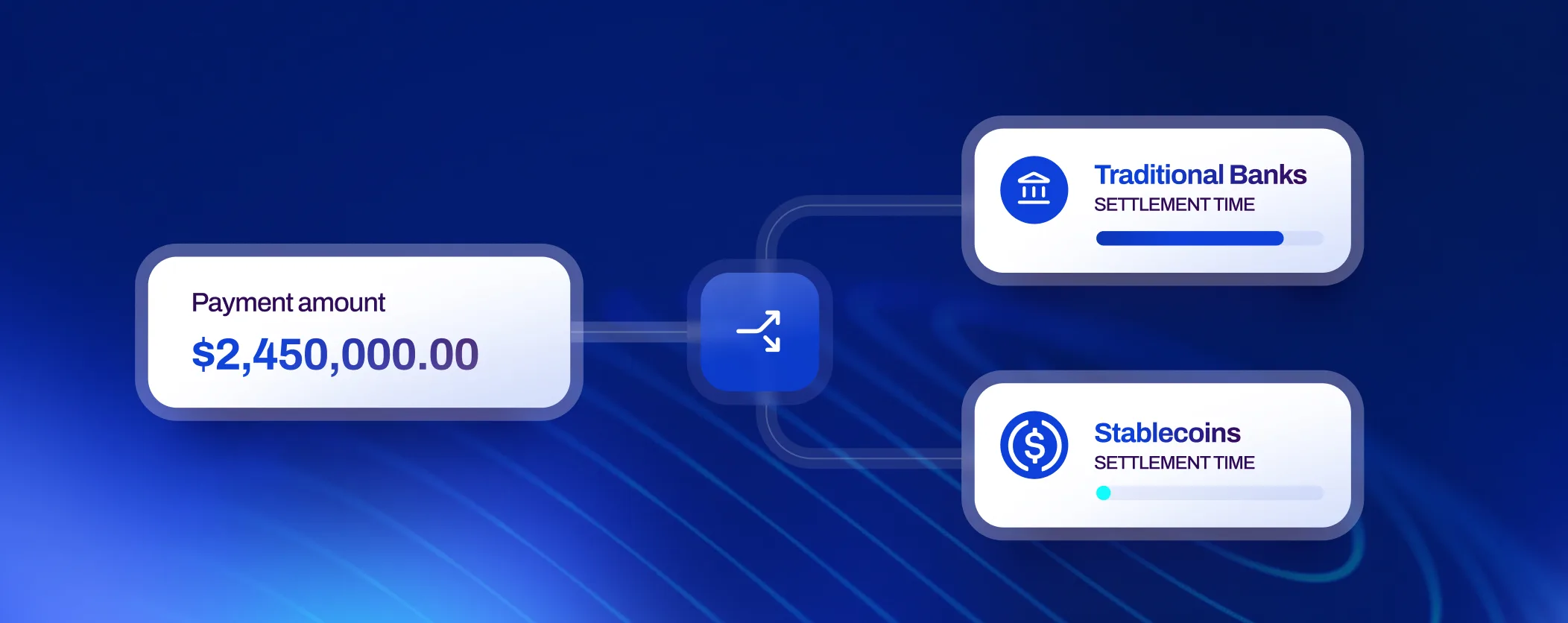
Stablecoins matter because they address real problems finance teams have managed for decades, from settlement delays to the operational friction of moving money globally.
That practical value is why payments are likely to drive the next phase of enterprise adoption.
The future is a dual-asset world
Questions about stablecoins are often framed as a choice between traditional finance and digital assets. That framing misses how enterprise finance actually works.
Banks will continue to play a central role in global commerce, and the systems that finance teams rely on today will remain essential.
The more likely path is addition. Businesses gradually adopt another way to move and manage money alongside the infrastructure they already trust.
At Velocity, we call that a dual-asset world.
Every global business will eventually operate with more than one way to move and manage money.
In that world, fiat and stablecoins complement one another, giving finance teams the flexibility to choose the approach that makes the most sense for a given payment, treasury workflow, or business objective.
Enterprise adoption changes the conversation
The first wave of stablecoin adoption was driven largely by crypto-native businesses.
The next wave will be different.
Large enterprises adopt new infrastructure carefully. They test, measure results, and integrate new capabilities into existing operations before expanding further.
That’s one reason our conviction has only continued to grow. The conversations we’re having today are very different from the ones we had even 12 months ago.
Increasingly, finance teams are moving past the question of why stablecoins matter and focusing on where they fit, which payment flows make sense to modernize first, and how to begin without disrupting the systems already in place.
To us, that is one of the clearest signs the market is maturing.
Looking ahead
The shift to onchain finance is likely to happen gradually.
Companies will begin by modernizing a payment flow. They’ll gain confidence, expand into additional use cases, and gradually rethink how money moves through the business. For many, that journey will start with payments before extending into broader treasury operations.
Ten years from now, finance teams will spend less time talking about “going onchain.” They’ll simply use the infrastructure that delivers the best outcome for the business.
In the early days of the internet, companies talked about “going online” with an internet strategy. Eventually, the internet became part of how every business operated, and the distinction stopped mattering.
Payments are on a similar path.
The decade ahead points toward a financial system where traditional infrastructure and stablecoin rails work together, giving businesses more flexibility, greater efficiency, and better ways to move and manage money.
.png)